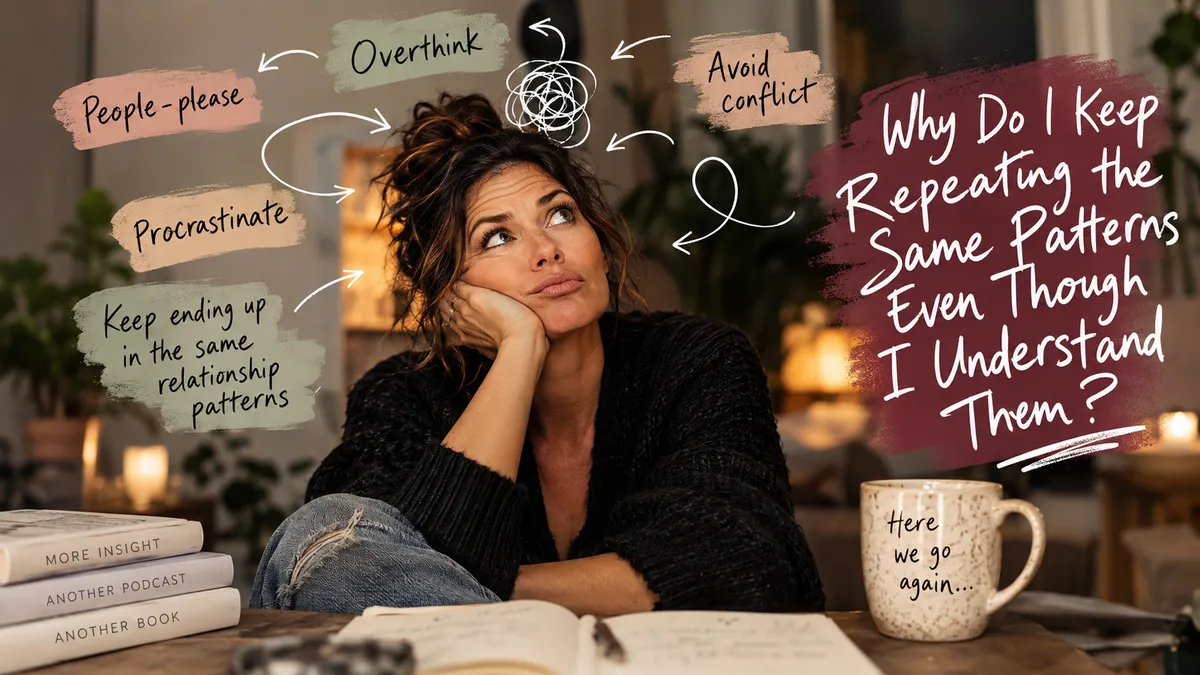
Why Do I Keep Repeating the Same Patterns?
You know why you do it. So why are you still bloody doing it?
We repeat patterns because our brains and nervous systems love familiarity and predictability over what is healthy.
Many of the behaviours we struggle with now started as ways to cope, stay safe, avoid conflict, feel loved or manage difficult emotions.
They worked. So we kept them.
The problem is, what protected you then might be limiting you now.
And knowing that doesn’t automatically change it.
You know you people-please. You know you overthink. You know why you avoid conflict, procrastinate or keep repeating the same relationship patterns.
You might even catch yourself doing it and think, Oh for God’s sake, here we go again.
Because understanding a pattern and changing a pattern are two very different things.
Why understanding your repeating patterns might not be enough
This might be controversial coming from a psychotherapist, but sometimes I think we’ve got enough insight. Another podcast, another book, another label, another hour analysing why Mum did what Mum did. All useful, but if you already know why you do something and you're still doing it, perhaps why isn't the question anymore.
Self-awareness is important. But self-awareness alone doesn't necessarily change behaviour.
I’m much more interested in:
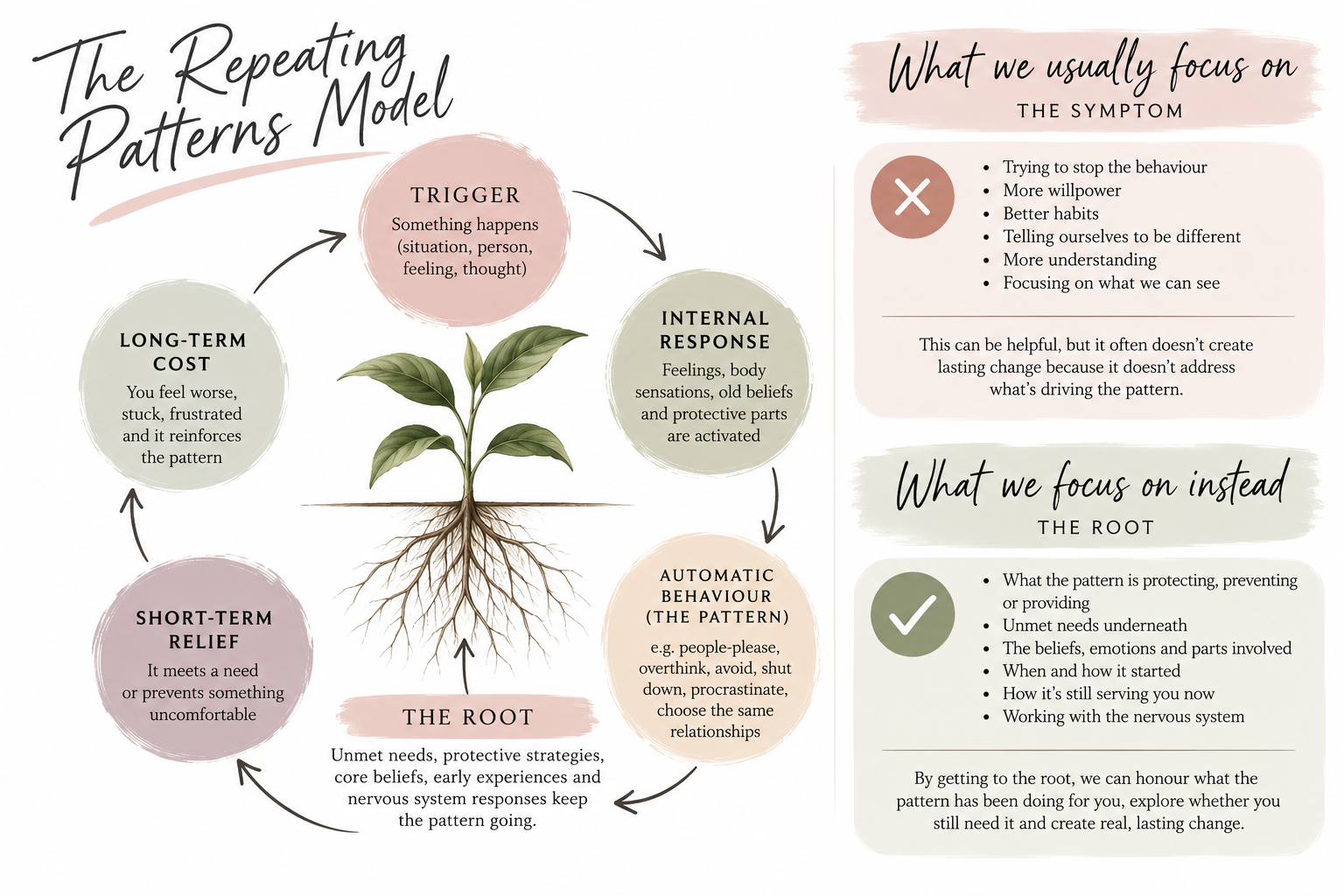
What is this behaviour doing for you?
Because we don’t tend to repeatedly do things for absolutely no reason. People-pleasing might keep you liked and accepted. Avoiding conflict might protect connection. Hyper-independence might mean you never have to risk relying on somebody who could let you down. Perfectionism might protect you from criticism. Procrastination might protect you from failure, judgement or even the expectations that could come with succeeding.
Overthinking can feel like control. If you consider every possible outcome, perhaps nothing can catch you off guard.
Suddenly these repeating patterns don’t look quite so ridiculous.
They make sense.
The problem is that the strategy may have outlived the circumstances that created it.
Why do we keep repeating familiar patterns?
This is another piece I think we underestimate.
We assume we'll naturally choose what makes us happy. But human beings are also drawn towards what we know.
And sometimes familiar can feel safer than different, even when familiar isn't particularly pleasant.
Relationships are a great place to see repeating patterns in action. You might keep choosing the same type of partner or find yourself in completely different relationships that somehow end up feeling remarkably similar.
Different person. Same dynamic.
You might repeatedly become the rescuer, the peacekeeper, the one chasing connection, the one doing all the emotional work or the one trying to prove you're worth choosing.
It doesn't mean you're consciously choosing bad relationships.
It might mean something about that dynamic is recognisable.
And recognising that gives us somewhere very different to work.
What if your repeating pattern isn't self-sabotage?
I’m not a huge fan of the term self-sabotage. We use it as though there's a rogue part of us deliberately trying to ruin our lives.
Especially when things are finally going well and suddenly we procrastinate, pick a fight, withdraw, overthink everything or find another way to derail ourselves.
Why do I always sabotage things when they're going well?
But what if you don't?
What if some part of you genuinely believes it's helping?
Success can create exposure. A healthy relationship can create vulnerability. Being seen can bring judgement. Change brings uncertainty.
Sometimes even getting what we consciously want takes us away from what we know.
So a much more useful question might be:
What does this pattern believe would happen if it stopped?
I know this repeating pattern personally
For years, I avoided confrontation. I would have told you I was keeping the peace.
Except I wasn’t.
I was keeping the peace outside of me while having an absolute bloody war inside.
I’d swallow what I wanted to say, replay conversations, think about what I should have said, monitor the other person and hold all that tension internally.
No confrontation. Job done.
Except the cost of avoiding external conflict was constant internal conflict.
Somewhere along the way I had learned that keeping the peace felt safer than risking the consequences of speaking. That pattern had a purpose.
But eventually I had to ask:
Do I still need it?
Not every repeating pattern looks like doing something
Some patterns look like disappearing.
Going quiet. Shutting down when things get difficult. Withdrawing. Avoiding the conversation. Emotionally checking out.
These are repeating patterns too.
Sometimes taking space is exactly what we need. But sometimes shutting down is an automatic protective response to conflict, overwhelm, rejection or simply feeling too much.
Again, I'm less interested in telling you to stop doing it and more interested in understanding what happens inside you that makes shutting down feel like the best available option.
The secondary gain behind repeating patterns
This is where the idea of secondary gain becomes really useful. Put simply, what are you getting from the thing you say you desperately want to stop doing?
Not consciously. Underneath it.
What does saying yes give you? What does staying busy prevent you from feeling? What does being the strong one protect you from? What does overthinking allow you to feel in control of? What does withdrawing protect? What does procrastinating postpone besides the task itself?
What does choosing the same kind of relationship allow you to recreate?
And what would happen if you actually let somebody help you?
Those questions are much more interesting to me than another list of things you should be doing differently.
Your repeating pattern might not be the real problem
People-pleasing, overthinking, procrastination, emotional eating, avoiding conflict, staying busy, choosing unavailable people, struggling to say no, over-explaining, withdrawing, taking responsibility for everybody else — these are the things we can see.
I want to know what’s underneath them.
What happens immediately before the behaviour? What changes afterwards? What does it help you avoid, gain, control or protect?
And perhaps most importantly:
What does some part of you think would happen if you stopped?
Why childhood patterns keep repeating in adulthood
We grow up.
Our circumstances change.
But that doesn't automatically mean everything we learned growing up gets updated with us.
A child who learned that keeping everybody happy maintained connection can become an adult who people-pleases.
A child who learned not to rely on anybody can become fiercely independent.
A child who learned conflict meant something bad was about to happen may become an adult who freezes, withdraws or does anything to avoid confrontation.
What protected the child can quietly restrict the adult.
This doesn't mean blaming everything on childhood.
It means recognising that some of our repeating patterns were learned in circumstances that no longer exist.
Your mind can know you're safe while the pattern keeps repeating
This is where insight can become incredibly frustrating.
Consciously, you know you're okay.
You know this person isn't your parent or your ex. You know disagreement doesn't automatically mean abandonment. You know making a mistake isn't catastrophic. You know you don't need everybody to like you.
And yet your heart races. Your stomach turns. You freeze. You want to run. You say yes when you meant no.
Your conscious mind can be saying “this is fine” while another response is already happening.
That's why telling yourself to just stop overthinking, just say no or just be more confident can feel so bloody useless.
When you've done the therapy and the same patterns keep repeating
This is one of the biggest reasons my own work has evolved beyond traditional talk therapy.
Talking is incredibly valuable and remains an important part of how I work. But after more than 20 years working therapeutically, I've seen the limitations of assuming conscious understanding automatically creates change.
Sometimes a client can explain their repeating patterns to me better than I can.
They've done therapy. Read the books. Joined the dots. They understand their childhood and can identify their triggers.
They don't need me to explain them to themselves again.
We need to explore what's maintaining the pattern now.
That's why I draw on psychotherapy, counselling, clinical hypnotherapy, NLP, Parts Work and nervous-system and trauma-informed approaches.
Sometimes we're working with a belief. Sometimes an emotion. Sometimes a younger part. Sometimes an identity you've carried for decades. Sometimes your body is still responding to something your conscious mind already knows is over.
And sometimes the unknown simply feels more threatening than the familiar pattern you say you desperately want to change.
Breaking repeating patterns doesn't mean endlessly digging up your childhood
Your history matters. Of course it does.
But I don't believe therapy needs to become an archaeological dig where we keep excavating your past hoping eventually we'll uncover the magic explanation that changes everything.
We honour what happened. We understand what you learned.
Then we look at whether those lessons are still relevant to the life you're living today.
Because a behaviour that helped the seven-year-old you, the teenager you or even the person you were ten years ago doesn't automatically deserve a permanent job.
Maybe the question is no longer:
“Why am I still like this?”
Maybe it's:
“What is this pattern still doing for me — and do I still need it?”
Because you might already understand why you keep repeating the same patterns.
The deeper work is discovering why some part of you still doesn't want to let them go.
Written by:
Hayley Perkins
Transactional Analysis Psychotherapist & Clinical Hypnotherapist
Ready to stop understanding the pattern and start changing it?
If you’ve read this thinking, “Yep. I know exactly what I do — I just can’t seem to stop bloody doing it,” perhaps it’s time to look at what’s really going on underneath.
You can book a free 20-minute call and we’ll have a chat about what’s happening and whether working together feels right.
Or, if you’re ready to get straight into it, book an Identity Shift session — 90 minutes focused entirely on you, the pattern you’re stuck in and what might actually be driving it.
Less analysing yourself. More getting to the root of what needs to change.
FAQ's
Why do I keep repeating the same patterns when I understand where they come from?
Because understanding a pattern consciously doesn’t necessarily change what’s driving it underneath. You can know exactly why you people-please, avoid conflict or overthink and still find yourself doing it. In my work, we move beyond why did this start? and explore what is maintaining it now and what some part of you still believes the behaviour is doing for you.
Why is it so hard to break old patterns?
Because most patterns aren’t random. At some point they probably helped you manage something — connection, rejection, conflict, uncertainty, criticism or feeling unsafe. I’m less interested in helping you fight the behaviour and more interested in getting to the root of why it still feels necessary.
Why hasn't talking about my patterns changed them?
Talking can be incredibly powerful, and psychotherapy is an important part of my work. But sometimes you’ve already talked. You’ve joined the dots. You know where it came from. You don’t need me to explain you to yourself again. That’s when working beyond the conscious understanding can be particularly useful.
How do you work with repeating patterns?
I combine psychotherapy with clinical hypnotherapy, Parts Work, NLP and nervous-system and trauma-informed approaches. We might work with a belief, an emotion, a younger part of you, a physical response or an identity you’ve carried for years. There’s no standard formula — we work with what’s actually keeping your pattern going.
How can clinical hypnotherapy help with repeating patterns?
Clinical hypnotherapy allows us to work beyond the constant analysing of the conscious mind and explore some of the beliefs, associations and emotional responses sitting underneath a pattern. It’s not about somebody taking control of your mind — you remain aware and involved. I use it alongside psychotherapy so we can work with both what you consciously understand and what may still be happening at a deeper level.
What is Parts Work and how can it help?
Parts Work starts from the idea that different parts of us can want very different things. One part might desperately want change while another is saying, Absolutely bloody not, that doesn’t feel safe. Rather than trying to silence or get rid of that protective part, we get curious about what it thinks it’s protecting you from and whether you still need that protection now.
Do we have to go back through my whole childhood to change a pattern?
No. Your history matters because it helps us understand what you learned, but I don’t believe therapy needs to become an archaeological dig through your entire life. We honour where a pattern came from, then work with what it’s doing inside you now. The goal isn’t to spend forever understanding your past; it’s to help you live differently in the present.
What if I've already done lots of therapy and personal development?
Then you’re very much my kind of client. Many people I work with arrive saying, “I’ve done the work, but…” They’re self-aware, they understand their patterns and often know exactly what they’d tell somebody else in the same situation. The missing piece isn’t necessarily more insight. Sometimes it’s working with the part of you that hasn’t caught up with everything your conscious mind already knows.
