
I Don't Know Who I AM Anymore
I Don’t Know Who I Am Anymore: When Your Life No Longer Feels Like You
There’s a particular feeling I hear women describe that’s hard to put into words.
“My life doesn’t feel like me anymore.”
“I don’t know who I am.”
“I’ve got everything I thought I wanted, so why am I unhappy?”
“There has got to be more to life than this.”
Feeling like you don’t know who you are anymore can happen when you’ve become disconnected from your own needs, values and emotions, or when the roles and identity that once fitted your life no longer feel like you.
Sometimes it shows up as restlessness. You want to change your job, your business, your relationship, your friendships, where you live… occasionally the bloody lot.
Sometimes it’s much quieter. Nothing dramatic has happened. You just don’t feel like yourself anymore. You feel lost or stuck and can’t quite put your finger on why.
So you Google things like Why do I feel stuck in my life? Why am I restless all the time? Why have I lost my spark? How do I find myself again? Am I having a midlife crisis?
But not knowing who you are anymore doesn’t automatically mean you’re having a midlife or identity crisis.
What if the person you’ve been simply doesn’t quite fit anymore?
What if you’re experiencing an identity shift — that uncomfortable space where the old version of you no longer fits, but you haven’t quite discovered who you are now?
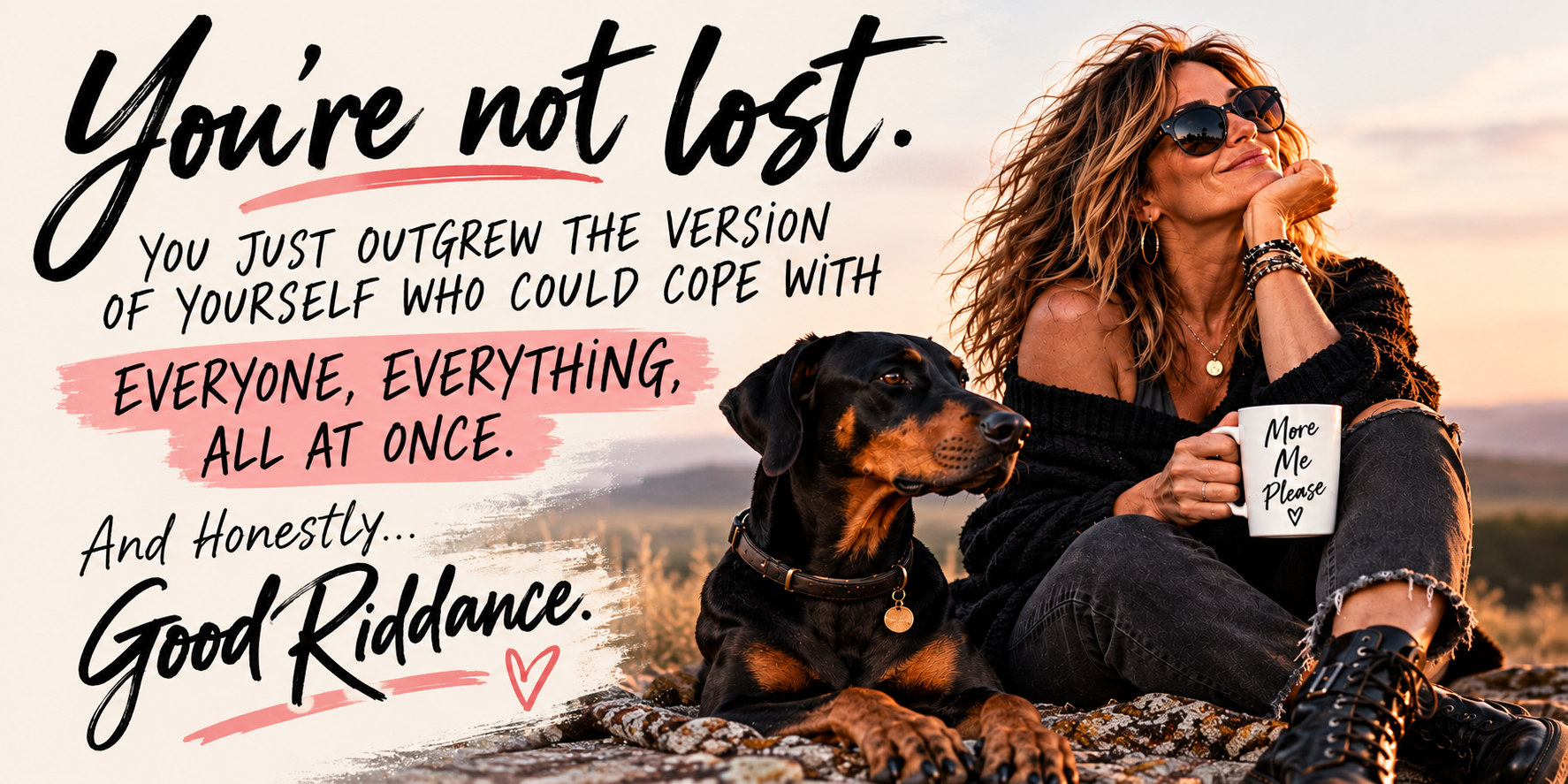
Maybe you’re not lost at all. Maybe you’re changing.
Maybe you’re not lost
When someone tells me, “I just want to find myself again,” I’m always curious about the word again. Again suggests there’s an old version of you somewhere that you need to get back to.
But what if there isn’t? What if the woman you were ten or twenty years ago isn’t missing? What if you’ve simply outgrown her? You’ve lived since then. Loved people. Lost people. Built things. Ended things. Changed your mind. Changed your priorities.
Maybe you don’t need to find yourself again. Maybe you need to discover who you are now.
Why do I feel lost in my 40s or 50s?
Because this is often the point where identities we’ve spent decades building start to shift. Children need us differently. Careers lose their pull. Relationships change. Parents age or die. Our bodies change. We go through grief, divorce, burnout, menopause, redundancy, retirement or simply a change in what matters.
And sometimes nothing obvious changes at all. We do. The life that fitted an earlier version of you can stop fitting the person you’ve become. That doesn’t necessarily mean something is wrong. It may simply mean something is changing.
Identity is more than knowing who you are
Identity is all the things you’ve come to believe about yourself. I’m strong. I’m independent. I’m successful. I’m the easy-going one. I’m the one everybody relies on. I cope. I don’t need help.
Over time, these things stop feeling like roles and become who we believe we are. That identity can influence what we tolerate, the relationships we stay in, the careers we keep, the boundaries we have and even what feels possible for us.
The tension starts when the identity that created your current life no longer fits the person trying to live the next part of it.
Who did you need to become?
This is often more useful than asking, “Who am I?” Who did you need to become?
Maybe being independent meant you couldn’t be let down. Maybe being successful gave you security or worth. Maybe being useful gave you connection. Maybe being easy-going kept conflict away. Maybe being the strong one meant nobody saw you struggle. Maybe looking after everybody else gave you purpose.
That’s why I’m interested in the secondary gain of identity. What does being the strong one give you? What does being needed protect? What does success prove? What does independence mean you never have to risk?
We often focus on the cost of an identity, but if it has survived for decades, there’s usually been a benefit too.
I have everything I wanted, so why am I unhappy?
This can come with a lot of guilt. You’ve got the family, the home, the career, the business, the life you worked for. So why are you dissatisfied?
Because gratitude and dissatisfaction can exist together. You can love your family and want more for yourself. You can appreciate the career you built and no longer want it. You can be grateful for your life and recognise that parts of it no longer fit.
The question doesn’t always need to be, “What’s wrong with my life?” Sometimes it’s, “Does the life I’ve created still reflect who I am now?”
I have a successful career but I’m unhappy
Work and identity get tangled very easily. You build the career, earn the money, become known for what you do, and maybe people even envy what you’ve created.
Then one day you realise you don’t bloody want it anymore.
And suddenly the question isn’t just, “What job would make me happy?” It becomes, “Who am I if I’m not this anymore?”
That’s why career change in your 40s or 50s can feel so destabilising. Sometimes we’re not frightened of changing the job. We’re frightened of who we’d have to become to do it.
Who am I outside of being a mum, partner, carer or professional?
Roles can take up so much space that we stop seeing ourselves outside them. Mother. Partner. Daughter. Carer. Business owner. Professional.
Then children grow up. Relationships end. Caring responsibilities change. Careers finish. Somebody dies. And suddenly there’s space.
That space doesn’t always feel like freedom. Sometimes it feels like loss. We don’t only grieve people, roles or stages of life. Sometimes we grieve who we were within them.
Why am I suddenly fed up with everyone?
Maybe everyone really has become more annoying. Entirely possible. 😂
But sometimes something else is happening. Perhaps you’ve spent years accommodating, keeping quiet, taking responsibility, saying yes and making things easier for everybody else. And suddenly you can’t bloody stand doing it anymore.
That doesn’t always mean the people around you have changed. Sometimes your tolerance for abandoning yourself has changed. You may not be fed up with everyone. You may be fed up with who you become around them.
Why don’t I know what I want anymore?
Because knowing what you want requires being able to hear yourself. If you’ve spent years asking what the children need, what your partner needs, what work needs, what clients need, what’s sensible and what keeps everybody happy, your own voice can get very quiet.
Then someone asks, “What do you want?” and you genuinely don’t know.
Don’t start with, “What do I want to do with the rest of my life?” Start smaller. What gives me energy? What drains me? What am I tolerating? What am I curious about? When do I feel most like myself? What do I secretly envy in other people’s lives?
Those questions often tell us far more than another five-year plan.
Why doesn’t anything excite me anymore?
Sometimes losing interest in things needs proper attention. Burnout, grief, depression, menopause, stress and physical health can all play a part.
But sometimes the things that used to excite us genuinely don’t anymore. We’ve changed. And we can waste a lot of energy trying to get our old spark back.
What if the spark hasn’t gone? What if it’s moved? Maybe you don’t want more achievement. Maybe you want more freedom. Maybe you don’t want bigger. Maybe you want slower. Maybe the old version of success simply doesn’t fit anymore.
That’s worth listening to.
Is this a midlife crisis?
Maybe. But I think we’re far too quick to pathologise the desire for change.
A woman reaches 45 and starts questioning the career, the relationship, the role, the expectations she’s tolerated for years? Midlife crisis.
Or maybe she’s finally reached the point where she knows herself well enough to realise she doesn’t want another twenty years of the same thing.
What if some of this isn’t crisis? What if it’s awareness?
What if I want to change everything?
Don’t panic. Wanting to change everything doesn’t necessarily mean everything needs changing.
Sometimes the fantasy tells you what you’re missing. If you fantasise about running away, what does that give you in your imagination? Freedom? Space? Rest? Adventure? Nobody needing anything from you?
Perhaps you don’t need to move to a hut in Portugal. Maybe you just need a bloody afternoon where nobody asks you for anything.
The fantasy is information.
Why identity change can feel unsafe
This is where identity becomes much more than mindset. If you’ve always been the strong one, asking for help can feel vulnerable. If you’ve always been liked, disappointing someone can feel threatening. If being needed gave you connection, becoming less available can feel risky. If success gave you worth, slowing down can feel like failure.
Your conscious mind can say, “This is what I want,” while another part of you says, “Absolutely not. We know how to survive here.”
That’s not necessarily self-sabotage. It may be protection.
Your nervous system doesn’t care about your vision board
You can create the most beautiful future-self vision imaginable: confident, boundaried, free, rested, doing work she loves.
But if becoming that woman requires you to behave in ways your system associates with rejection, uncertainty or danger, you may keep returning to the familiar version of you.
That’s why I’m interested in questions like: Can I be loved and still have boundaries? Can I belong without being useful? Can I rest without earning it? Can I disappoint somebody and still be okay? Can I let somebody help me?
That’s where identity work starts going underneath the surface.
Parts of you may want completely different things
One part wants freedom. One wants certainty. One wants to be seen. One wants to hide. One wants to leave the job. One wants the pension. One wants adventure. And another wants everybody to calm the fuck down because we have responsibilities. 😂
This is where Parts Work can be so useful. Rather than deciding one part is right and another is sabotaging you, we get curious about all of them. What does each part want? What is it frightened of? What is it trying to protect?
Sometimes the part resisting change isn’t the problem. It’s the part that needs to feel safe enough for change to happen.
Maybe you don’t need to reinvent yourself either
There’s a lot of talk about midlife reinvention. I’m not sure you need to completely reinvent yourself. That sounds exhausting.
I’m more interested in evolution. What stays? What goes? What have you outgrown? What have you been carrying because somebody else expected you to? What still feels completely yours?
You don’t have to destroy the woman you’ve been. You just get to be more conscious about what you carry forward.
Stop trying to get back to who you were
I hear this a lot in therapy: “I just want to get back to how I used to be.”
But what if there is no going back? Not because something is broken, but because life has happened.
Maybe the next version of you isn’t behind you. She’s in front of you.
And constantly trying to recover the woman you used to be may stop you noticing the woman you’re becoming.
When you understand yourself and still feel stuck
You might know your childhood stuff. Know your triggers. Know your attachment style. Know why you people-please. Know why you’re independent. And still think, “Okay. But what now?”
This is where my own work has moved beyond insight alone. I draw on psychotherapy, counselling, Transactional Analysis, NLP, Advanced Clinical Hypnotherapy, Parts Work and principles from Internal Family Systems, alongside trauma-informed and nervous-system-informed approaches.
Sometimes we’re working with a belief. Sometimes a protective part. Sometimes a subconscious association. Sometimes grief. Sometimes safety. Sometimes an identity you’ve worn for so long you stopped noticing you were wearing it.
The question becomes less, “Why did I become this person?” and more, “Does this version of me still belong in the life I want now?”
You don’t need to know who you’re becoming yet
The middle bit is uncomfortable. The old identity doesn’t fit, but the new one isn’t clear. So we interpret that uncertainty as being lost.
Maybe you’re not lost. Maybe you’re in transition.
You don’t need to know exactly who you’re becoming. You can experiment, try things, change your mind, notice yourself, follow curiosity, say no, say yes, and do something completely pointless because you enjoy it.
Identity is allowed to evolve.
So how do I find myself again?
Maybe you don’t.
Maybe the better questions are: Who have I needed to be? What has that version of me given me? What has she cost me? Which parts still feel like me? Which parts am I exhausted by? What am I afraid would happen if I changed? What do I want more of? What am I ready to stop carrying?
And ultimately: Who am I becoming?
You don’t need the whole answer today. But perhaps it’s time to stop searching for the woman you used to be.
She’s already done her job.
Hayley Perkins
Psychotherapist & Clinical Hypnotherapist
Therapy for Identity, Feeling Lost and Midlife Change Near Stamford
I’m Hayley Perkins, a Psychotherapist and Advanced Clinical Hypnotherapist near Stamford, with more than 20 years’ experience working therapeutically with people.
I work particularly with women who reach a point where “I’m fine” is no longer enough. Women who find themselves thinking “I don't know who I am anymore”, or asking: Who am I now? Why do I feel stuck? Why doesn’t my life feel like me anymore? What do I want from the next stage of my life?
My work isn’t about telling you who you should become, and it isn’t about spending forever analysing who you’ve been. We understand what shaped you, what your current identity has been doing for you and what may still be keeping it in place, then we look at what comes next.
Because perhaps you’re not having a midlife crisis. Perhaps you’re not lost.
Maybe you’ve simply reached the point where the person you’ve been can no longer contain the person you’re becoming.
Ready to explore who you are now?
If you've read this thinking “Bloody hell, this is me. I genuinely don't know who I am anymore,” you don't need to have the answer before you ask for support.
In fact, that's rather the point.
We can explore what's changed, the identities and roles you've outgrown, what you're still holding onto and what might be making it difficult to move towards whatever comes next.
You can book a free 20-minute call to talk about what's happening and whether working together feels right.
Or, if you want to get straight into the work, you can book an Identity Shift session — 90 minutes focused on where you are now, what's keeping you stuck and beginning to understand what you actually want next.
You don't need to find the old you. We can start with getting curious about the woman you are now
Frequently Asked Questions
Why do I feel like I don't know who I am anymore?
Sometimes this feeling appears when the roles, priorities or identities that have shaped your life no longer fit in quite the same way. You may have changed even though your external life hasn't.
Rather than meaning you've completely lost yourself, “I don't know who I am anymore” can sometimes signal a period of identity transition — the old version of you doesn't quite fit, while what's next hasn't become clear yet.
In my work, we can explore what has changed, what you've outgrown and which parts of your identity still genuinely feel like you, rather than assuming there's an old version of yourself you need to get back to.
Is it normal to feel lost in your 40s or 50s?
It isn't unusual for questions about identity to become more noticeable during periods of significant life change. Children growing up, menopause, changing relationships, bereavement, career changes, burnout or simply shifting priorities can all make you question roles you've occupied for years.
Sometimes the question isn't “What's gone wrong?” but “Who am I now that my life is changing?”
Therapy can give you somewhere to explore that question without needing to immediately make huge decisions or have a five-year plan. Sometimes we start simply by noticing what no longer fits and what you're beginning to want more of.
How do I find myself again when I don't know who I am?
I'd start by taking some pressure off the word again.
You may not need to recover an earlier version of yourself. Begin by noticing what gives you energy, what drains you, what you tolerate, what you're curious about, when you feel most like yourself and what you want more or less of.
You're not necessarily trying to find the person you were. You may be discovering who you are now.
This is something I explore a lot with clients — separating who you genuinely are from who you've learned or needed to be. That might mean looking at roles, values, beliefs, relationships, expectations and the protective parts of you that may be understandably nervous about doing things differently.
Can therapy help if I don't know who I am anymore?
Yes, therapy can give you space to explore what has changed, the identities and roles you've developed, what they've provided or protected you from and why moving away from them might feel harder than you expected.
My work goes beyond simply talking about and understanding what's happened. I combine psychotherapy, Advanced Clinical Hypnotherapy, Parts Work, NLP and nervous-system and trauma-informed approaches, depending on what you need.
Sometimes we're working with beliefs. Sometimes a protective part. Sometimes an old emotional response. Sometimes the expectations you've placed on yourself for decades.
Because you may already consciously know what you want to change. The work is often understanding what is making it so difficult to actually do it.
How do I know if I'm having a midlife crisis or an identity shift?
There isn't a simple test that separates the two, and feelings of restlessness or dissatisfaction can have many causes.
Rather than rushing to label the experience, I think it's much more useful to get curious about what has changed, what no longer fits and what you're beginning to want differently.
That's how I'd approach it therapeutically too. We wouldn't start from the assumption that you're having a crisis or that everything in your life needs changing. We'd explore what's underneath the restlessness and what it might be telling you.
Sometimes you don't need to blow your whole bloody life up.
You need enough space to hear yourself again.
If you're experiencing persistent low mood, loss of interest or other symptoms that are significantly affecting everyday life, it's also important not to assume they're just an identity shift and to seek appropriate professional support.
